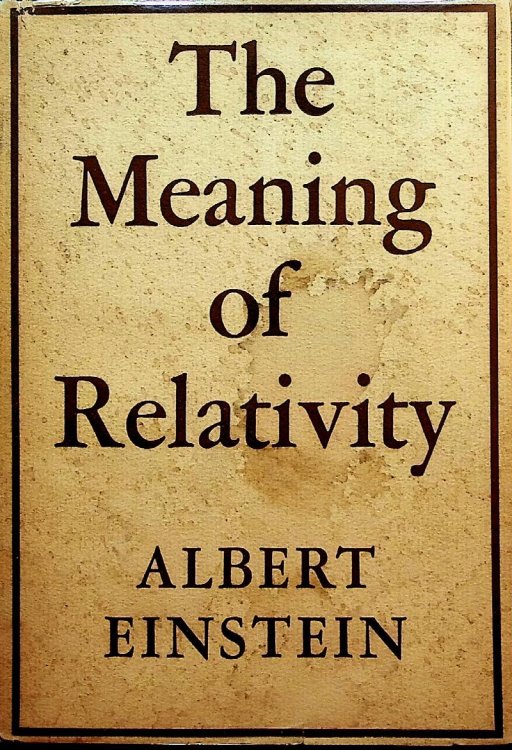
The Meaning of Relativity
$450.00 USD • Used
1945 LANDMARK SUMMARY OF NOBELIST ALBERT EINSTEIN'S THEORIES THAT ESTABLISHED MODERN PHYSICS--COPY OF NOBELIST CARLETON GAJDUSEK WHO DISCOVERED KURU, THE FIRST PRION DISEASE.
8 inches ta...
1945 LANDMARK SUMMARY OF NOBELIST ALBERT EINSTEIN'S THEORIES THAT ESTABLISHED MODERN PHYSICS--COPY OF NOBELIST CARLETON GAJDUSEK WHO DISCOVERED KURU, THE FIRST PRION DISEASE.
8 inches tall hardcover, gray cloth binding, gilt title to spine, decorative bookplate of D. Carleton Gajdusek to front paste-down, signature of D. Carleton Gajdusek to front free endpaper, [vi], 135 pp, near fine in very good+ unclipped jacket with faint splash mark to cover, light wear to spine ends and corners, in protective mylar sleeve. This first printing of the second edition contains an appendix added by the author discussing advances in the theory of relativity since the first edition in 1921.
ALBERT EINSTEIN (1879 - 1955) was a German-born theoretical physicist, widely acknowledged to be one of the greatest and most influential physicists of all time. Einstein is best known for developing the theory of relativity, but he also made important contributions to the development of the theory of quantum mechanics. Relativity and quantum mechanics are together the two pillars of modern physics. In 1922, he was awarded the 1921 Nobel Prize in Physics for his services to Theoretical Physics, and especially for his discovery of the law of the photoelectric effect. The Meaning of Relativity: Four Lectures Delivered at Princeton University, May 1921 is a book published by Princeton University Press in 1922 that compiled the 1921 Stafford Little Lectures at Princeton University, given by Albert Einstein. The lectures were translated into English by Edwin Plimpton Adams. The lectures and the subsequent book were Einstein's last attempt to provide a comprehensive overview of his theory of relativity and is his only book that provides an accessible overview of the physics and mathematics of general relativity. The book is made of four lectures. The first is titled Space and Time in Pre-Relativity Physics. The second lecture is titled The Theory of Special Relativity and discusses the special theory of relativity. The third and fourth lectures cover the general theory of relativity in two parts. Einstein added an appendix to update the book for its second edition, published in 1945 (offered here).
PROVENANCE: DANIEL CARLTON GAJDUSEK (1923-2008) was an American medical doctor and researcher who was co-recipient of the Nobel Prize in Physiology or Medicine in 1976 for his work in Kuru, the first prion disease. Gajdusek graduated from Harvard Medical school at age 23, served as head of virological and neurological research at the National Institute for Health in 1958; and inducted into the National Academy of sciences in 1974. Gajdusek's best-known work focused on kuru. This disease was rampant among the South Fore people of New Guinea in the 1950s and 1960s. Gajdusek connected the spread of the disease to the practice of funerary cannibalism by the South Fore. With elimination of cannibalism, kuru disappeared among the South Fore within a generation. He proved his hypothesis by successfully transmitting the disease to primates and demonstrating that it had an unusually long incubation period of several years. This was the first demonstration of the infectious spread of a noninflammatory degenerative disease in humans. Subsequently, additional human agents belonging to the same group were discovered. They include sporadic, familial, and variant Creutzfeldt-Jakob disease. Gajdusek recognized that diseases like Kuru and Creutzfeldt-Jakob disease were caused by a new infectious agent that had not yet been identified.
Product Info
Publisher: Princeton University Press
Year: 1945
Type: Used
Binding: Softcover
Seller Info
BiomedRareBooksLLCABAAILABIOBA
Address: P.O. Box 193 North Garden, Virginia
Website: https://www.biomedrarebooks.com
Country: United States

![Die Missbildungen des Menschen [Human Malformations]](https://www.biomedrarebooks.com/assets/images/product/1696_1.jpg)
![Observationes Circa Viventia, Quae in Rebus Non Viventibus Reperiuntur. Cum Micrographia Curiosa Sive Rerum minutissimarum Observationibus, quae ope Microscopij reconitae ad vivum esperimuntur. His accesserunt aliquot Animalium Testaceorum Icones non antea in lucem editae. Omnia Curiosorum Naturae Exploratorum Utilitati & Iucunditati expressa & oblata [Observations about living things, which are found in non-living things: with curious micrographs: to these are added some icons of shell animals not previously published]](https://www.biomedrarebooks.com/assets/images/product/1781_4.jpg)

![170 Chromotafeln aus Brehms Tierleben. Sugetiere (Band I-III; 52 Tafeln); Vgel (Band IV-VI; 55 Tafeln); Niedere Tiere (Band VII-X; 63 Tafeln). 3 Bnde. [170 chromolithographs from Brehm's Animal Life. Mammals (Volumes I-III; 52 plates); Birds (Volumes IV-VI; 55 plates); Lower Animals (Volumes VII-X; 63 plates). 3 volumes.]](https://www.biomedrarebooks.com/assets/images/product/1817_1.jpg)